
Agents
Identity, routines, tools, and knowledge: the model behind everything.
Overview
An agent is a named AI worker with a job, the tools to do it, and the knowledge it needs. Your customer-facing agent is one. The Onboarding Agent in your workspace is one. You'll build more.
Concretely, an agent has:
- A name people see ("Acme Support Agent," "Releases Helper").
- Instructions that say what it does and what it should not do.
- Tools it can call during a session (search, knowledge lookup, open a PR, post in Slack, anything you've attached).
- Knowledge it can look up (your runbooks, your repos, the websites you've connected).
- Memory it carries between sessions.
- Routines that fire when something happens in a thread.
It is not a prompt or a single workflow run. An agent is a persistent identity. The same Acme Support Agent shows up in each customer network it's on. The same routines fire every time a message lands in a thread that agent is on. The agent is the thing you manage; the runs are what it produces.
Object Relationships
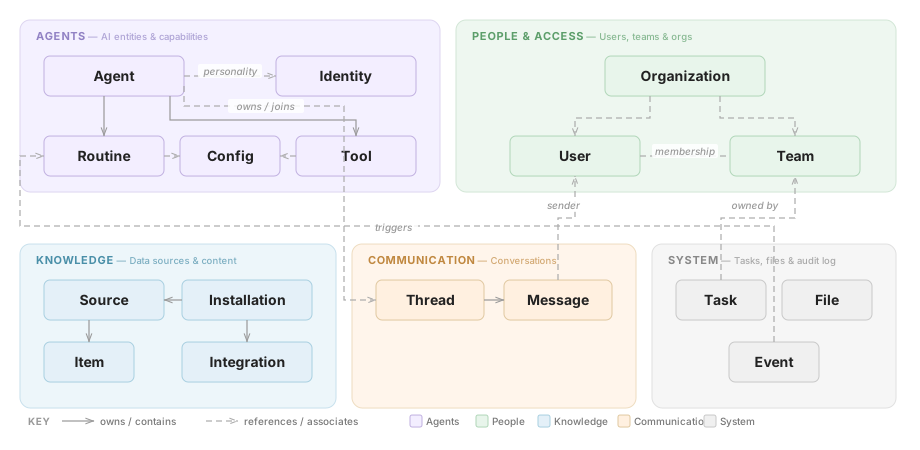
Agent is the center of the model. Follow the arrows to see how the other pieces connect to it:
- An Agent has Routines (automations), Tools (capabilities), and a profile/instructions layer shown here as Identity
- Agents join Teams alongside Users, grouped under Organizations
- They communicate via Threads containing Messages
- They draw context from Sources (knowledge bases) connected through Installations
Solid arrows = owns / contains · Dashed arrows = references / associates
The core message flow is simple:
- A person or system sends a message in a thread.
- The platform checks whether any agent routines should react.
- The agent uses its instructions, tools, and knowledge to decide what to do.
- The agent replies, takes an action, or starts additional work.
This is the flow you are building on top of.
Creating an agent
You already have the Onboarding Agent in your workspace, and you build your customer-facing agent in onboarder Step 3. Most of the time you'll add new ones for internal jobs (monitoring, reporting, ops) rather than customer-facing work.
Create one from the CLI:
archagent create agent -n "Support Agent" -k support-agent \
  -i "You help users resolve billing and support issues with short, concrete answers."
Flags:
-n(or--name): the display name people see.-k(or--lookup-key): a stable handle your scripts and configs reference (support-agent, not the auto-generated ID).-i(or--identity): the system prompt that defines the agent's role.
The agent persists in your workspace. From here, attach tools, knowledge, and routines, then deploy.
Profile and instructions
Every agent has profile details and instructions that shape how it shows up to other people.
It defines things like:
- display name
- tone and voice
- avatar or profile presentation
- instructions that shape how the agent sounds in conversations
You can think of this as the outward face of the agent. The agent is the same worker underneath; these settings shape how it appears and communicates.
Update instructions, name, and profile details from the CLI or an agent template. In ArchAgents Portal, open Agents and click into an agent for a visual view you can review and edit.
Routines
Routines give the agent ongoing behavior.
They answer two practical questions:
- When should this agent act?
- What should it do when that happens?
For example, you can create a routine that runs when a new message appears:
archagent create agentroutine --agent <agent_id> \
  -n "billing-triage" \
  -e thread.message_added \
  -t script \
  --script "{ route: \"billing\", priority: \"high\" }"
archagent activate agentroutine <routine_id>
New routines start in draft, so save the routine ID from the create command and activate it when you want the handler to run.
Common routine patterns
- reply when a new message arrives
- run on a schedule
- react when a person joins a thread
- respond when new knowledge or integration data becomes available
Handler types
| Handler type | When to use | What runs |
|---|---|---|
preset: participate |
Agent should join and respond in a thread conversation | Built-in conversation handler that posts the agent's response into the thread |
preset: triage |
Agent mostly needs a local/embedded environment to do real work | Joins the conversation like participate, but acknowledges and tracks work on the thread task list (claiming itself as owner) instead of attempting it from the cloud |
preset: send_message |
Agent should compose one message for a thread after an event or invocation | One-shot LLM session whose result is delivered to the target thread |
preset: auto_memory_capture |
Extract and store key facts when a conversation ends (opt-in) | Built-in memory extraction |
preset: do_task |
Scheduled, event-driven, or explicitly invoked work | Full LLM session with all agent tools; result stays on the run unless the invocation specifies delivery |
script |
Deterministic logic (routing, filtering, transformations) | ArchAgents script expression |
workflow_graph |
Multi-step process with branching or approvals | Workflow config |
chain |
A few handlers should run in order, each step's output feeding the next | Linear sequence of preset / script / workflow_graph steps |
participate vs. do_task — pick based on where the result should go:
- Use
participatewhen the agent should reply inside a thread. The preset handles the thread-side mechanics and the user sees the agent's response as a thread message. - Use
do_taskfor scheduled summaries, batch analysis, periodic audits, and explicit invocations. By default its result is inspected viaarchagent list agentroutinerunsor the activity feed. An explicit invocation can also request delivery to a message or thread.
do_task is more powerful (full LLM reasoning with every tool attached). Use participate for live turn-by-turn conversation, or send_message when one event should produce one thread reply.
triage for embed-gated agents. Some agents are only useful when running embedded — running locally as the agent, with access to a real environment (terminal, files, repository). In the cloud they can't clone a repo or run a test suite, so a participate routine would just produce replies it can't back up. Use triage instead: it joins the same thread.session.join session, but when a request needs hands-on local work it posts a brief acknowledgment and records the work as a Task — claiming itself as the owner — then completes it the next time it runs embedded. The triage routine is always given the tasks tool, even if the agent didn't enable it. Every agent's prompt also explains the per-message agent_mode attribute (embedded, cli, or absent for cloud) so agents can tell which work needs a local session.
For a first agent, start with participate (so it responds in conversations) and auto_memory_capture (opt-in memory extraction — the agent creator adds this routine to enable it; it is not on by default).
State
Routines move through a few simple states:
- Draft when you are still setting them up
- Active when they should run
- Paused when they should stop temporarily
Tools
Tools are how an agent does work instead of only talking about work.
Some tools come from the platform, such as messaging, search, or computer-use capabilities. Others are custom tools you define for your own services.
Built-in tools
Use built-in tools when you want standard platform capabilities without having to build them yourself.
Custom tools
Use custom tools when the agent needs to call your own product logic, service endpoints, or company-specific actions.
Read Tools for the real operator workflow: attach, inspect, activate, and run tools through an embed session.
Knowledge
Knowledge is the information the agent is allowed to use.
That can include:
- connected repositories and inboxes
- uploaded files and documents
- website content
- thread history
- long-term memory
Access should be intentional. Give an agent only the knowledge it actually needs.
Sources and installations
There are two objects to understand here:
- Installation: a connected external service, account, or integration
- Source: a specific knowledge feed the agent can use from that installation
That means:
- connect a system or source
- activate it for the agent
- let the platform make that knowledge available when the agent needs it
Read Knowledge for the operational model: integrations, sources, ingestions, items, and the debugging loop around them.
Structured output
By default, an agent responds with free-form text. When you need the response to fit a known shape — for downstream automation, for inter-agent handoffs, or for content policy enforcement — attach an AgentMessageSchema to the routine.
The schema is a JSON Schema that constrains the agent's output. Required fields, enums, nested objects, and array shapes are all enforced before the response is accepted. You can also attach field guards to a schema to run content policies (regex, substring, or LLM-based) on each resolved field value.
routines:
  - name: customer-triage
    handler_type: preset
    preset_name: do_task
    preset_config:
      structured_message_template_refs:
        - "#/schemas/customer-summary"
    status: active
See Structured Output for the schema model and Field Guards for the content policy layer.
Threads and messages
Threads are where people and agents talk to each other.
Messages are the individual events inside those threads. A person can send a message, an agent can respond, and routines can use those events to drive behavior.
You can test that flow quickly from the CLI:
archagent create thread -t "Billing support" --owner-type agent --owner-id <agent_id>
archagent create user --system-user -n "Demo User"
archagent create threadmember --thread <thread_id> --user <user_id>
archagent create threadmessage --thread <thread_id> --user <user_id> \
  -c "I need help with invoice INV-2041"
This creates the flow most developers care about:
- a message arrives
- the platform gathers the right context
- the agent decides what to do
- the agent replies, uses tools, or pulls in more knowledge
Best practices
- Give each agent a narrow, understandable job.
- Add only the routines the agent really needs.
- Give the agent only the tools and knowledge it should have.
- Test new behavior in a sandbox before wider rollout.
- Review agent behavior regularly and refine instructions, routines, and access as you learn what works.
Deploy from a template
The recommended workflow is to write an agent.yaml file (an AgentTemplate) and deploy it in one command:
archagent deploy agent agent.yaml --name "Support Agent"
This creates the agent AND provisions all tools, routines, and installations in one command.
Minimal AgentTemplate example
kind: AgentTemplate
agent_key: support-agent
name: Support Agent
model: openrouter/anthropic/claude-sonnet-latest
identity: |
  You help users resolve billing and support problems with short, concrete answers.
  Always ask one clarifying question before taking action.

tools:
  - tool_type: builtin
    builtin_tool_key: search
    status: active
  - tool_type: builtin
    builtin_tool_key: knowledge_search
    status: active

routines:
  - name: Reply to messages
    description: Respond when a new message arrives
    handler_type: preset
    preset_name: participate
    event_type: thread.session.join
    event_config:
      thread.session.join:
        filters: {}
    status: active

installations:
  - install_type: memory/long-term
    config: {}
Key fields
identity-- system prompt and instructions that define the agent's behavior and boundaries.model-- primary model for agent reasoning and replies. Start withopenrouter/anthropic/claude-sonnet-latestunless you need a specific provider; accepted formats areanthropic/<model>,openai/<model>,google/<model>,xai/<model>,meta/<model>,fireworks/<model>,vertex/<model>, andopenrouter/<vendor>/<model>.tools-- builtin or custom tools the agent can use. Builtin tools reference abuiltin_tool_key; custom tools reference a handler and config.routines-- event handlers that give the agent ongoing behavior. Each routine specifies ahandler_typeand anevent_type.handler_typevalues:preset(built-in behavior),script(custom logic),workflow_graph(multi-step workflows),chain(a linear sequence of preset / script / workflow_graph steps — see Scripts → Chain-step input shape for how scripts inside chain steps read their input).preset_namevalues:participate(join conversations),triage(join conversations but acknowledge and track work on the task list for agents that need a local/embedded environment),send_message(compose and deliver one message),auto_memory_capture(opt-in: extracts and stores key facts after sessions when enabled by the agent creator),do_task(execute instructions on an event, schedule, or explicit invocation).event_typevalues:thread.session.join,thread.session.leave,thread.message_added,schedule.cron.- For cron routines, add
schedule: "0 9 * * 1"(a cron expression in UTC) alongsideevent_type: schedule.cron.
installations-- connected capabilities such as memory, integrations, and knowledge sources. See Installations for the full list of kinds.
Validate before deploying
archagent validate configs --kind AgentTemplate --file agent.yaml
Run this before deploy to catch schema errors early.
Have feedback?
Help us make this page even more useful.
Tell us what you'd like to see expanded, which examples would help, or what workflow you want covered next. Every message gets read.